

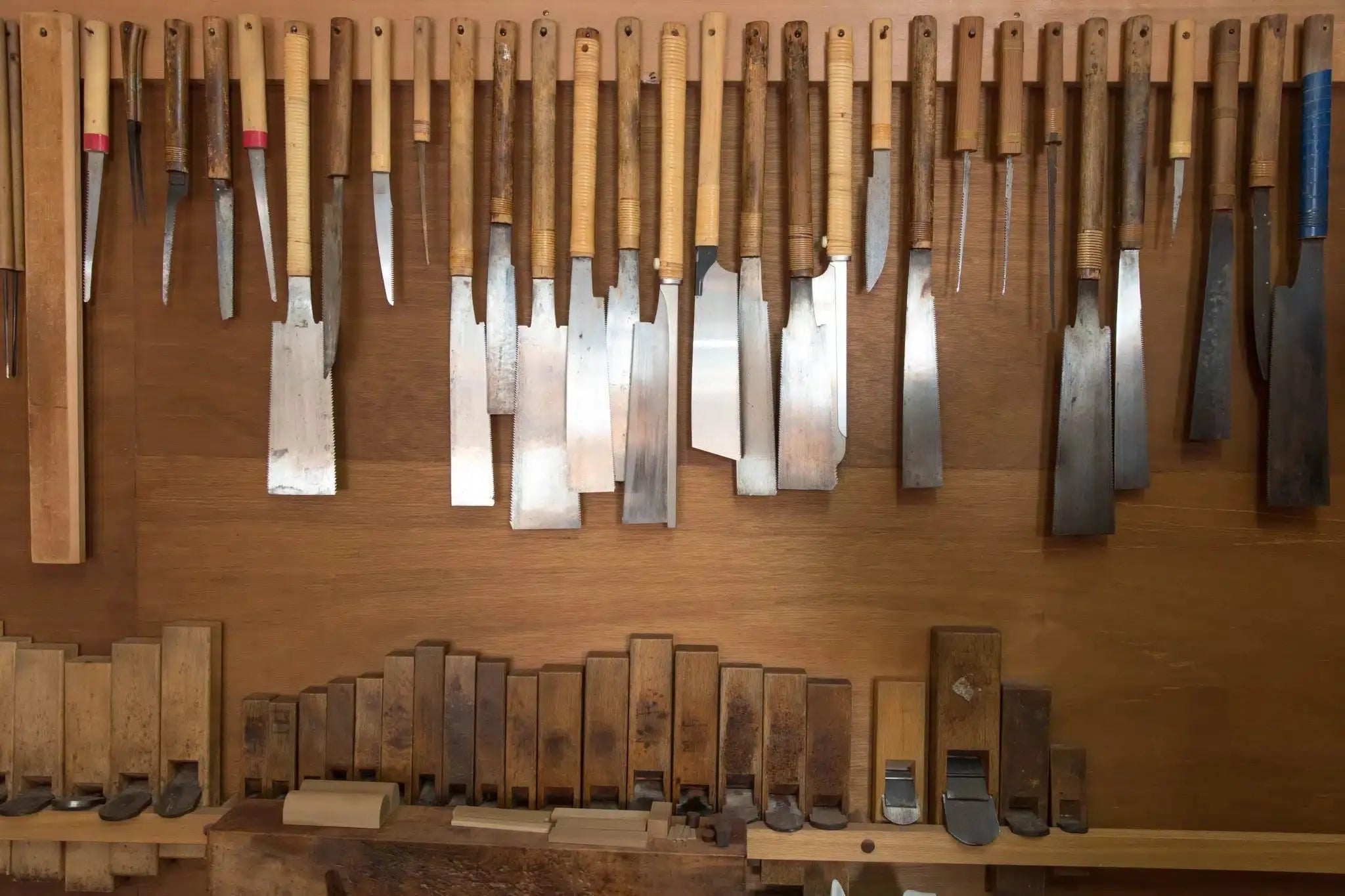
The philosophy of the Japanese tool
Japanese tools are distinguished by their precision and the philosophy behind them. For a Japanese craftsman, the tool is an extension of the hand. It is not simply a means, but an integral part of the creative process. This is why tools are often custom-made, adapted to the individual hand and preferences of each craftsman. The concept of transmission is also essential. These tools, sometimes passed down from generation to generation, embody both history and innovation.
Japanese tools: typologies and functions
One of the fascinating aspects of Japanese tools is their diversity and specialization. Here are some of the most iconic tools used by cabinetmakers, luthiers, and woodworkers, and some of the ones we sell.
The Japanese Plane (Kanna)
The Kanna is arguably the most iconic tool of the Japanese woodworker. Unlike Western planes, which are pushed, the Kanna is designed to be pulled towards the user. This allows for superior control and a finer cut. The Kanna is used to achieve incredibly smooth, almost mirror-like surfaces without the need for sanding. The quality of the blade, made of hard steel forged on a soft steel base, allows for an incomparable cutting precision.
The Japanese saw (Nokogiri)

The Nokogiri differs from Western saws in that it also cuts by pulling. This approach allows for a finer, more controlled cut with less effort. There are different variations of Japanese saws depending on the use: the Ryoba has a double blade with different teeth on each side (for cross and longitudinal cutting), while the Dozuki is a rigid back saw, ideal for precise cuts such as dovetails. Discover our collection of Japanese saws: https://ahmuvr-1w.myshopify.com/collections/scies-japonaises
The wood chisel or Nomi
Japanese Nomi knives are distinguished by their robustness and sharpness. Composed, like many Japanese tools, of a soft steel core and a hard steel blade, they offer excellent durability and superior cutting quality. Nomi tools are used for a variety of tasks, from roughing out to finishing complex pieces. Their ergonomic shape and perfect balance make them a preferred tool for cabinetmakers and luthiers.
The Sumitsubo
The Sumitsubo is a traditional tool used to mark straight lines on wood before cutting it. It consists of a small ink reservoir and a wheel that allows for drawing very fine lines. This tool perfectly symbolizes the precision of Japanese work: each cut must be perfectly measured and executed with rigor.
The Japanese hammer (or Genno)
The Japanese hammer, or Genno, is distinguished by its simplicity and balance. Unlike Western hammers, the Genno is often lighter, but its design allows for high precision and optimal impact. It is used in combination with Nomi for assembly work, as well as in instrument making to adjust pieces of wood without damaging them.
A constant source of inspiration
For woodworkers, Japanese tools represent much more than simple working instruments: they embody a philosophy of precision, respect for materials and gesture. Mastering Japanese tools takes time, but for those who dedicate themselves to it, it is a true journey into the heart of exceptional craftsmanship.
If you would like to learn more, you can watch a video about the history and manufacture of Ichiro Hattori knives: https://www.youtube.com/watch?v=GbNW1yPww3c


